If you or someone you love lives with sickle cell disease, you may have heard of hydroxyurea (also called hydroxycarbamide). It is currently the most widely used and best-studied medicine for reducing the frequency and severity of sickle cell crises, and it is available in Ghana.
In 2019, Ghana became the first country in Africa to commit to offering hydroxyurea as the standard of care for people with sickle cell disease, and in 2022, the government announced coverage through the National Health Insurance Scheme.
This guide explains how hydroxyurea works, what the evidence says, who should take it, what side effects to expect, and how to access it in Ghana. It is written for patients and families, not doctors, but it is grounded in the same evidence your doctor uses.
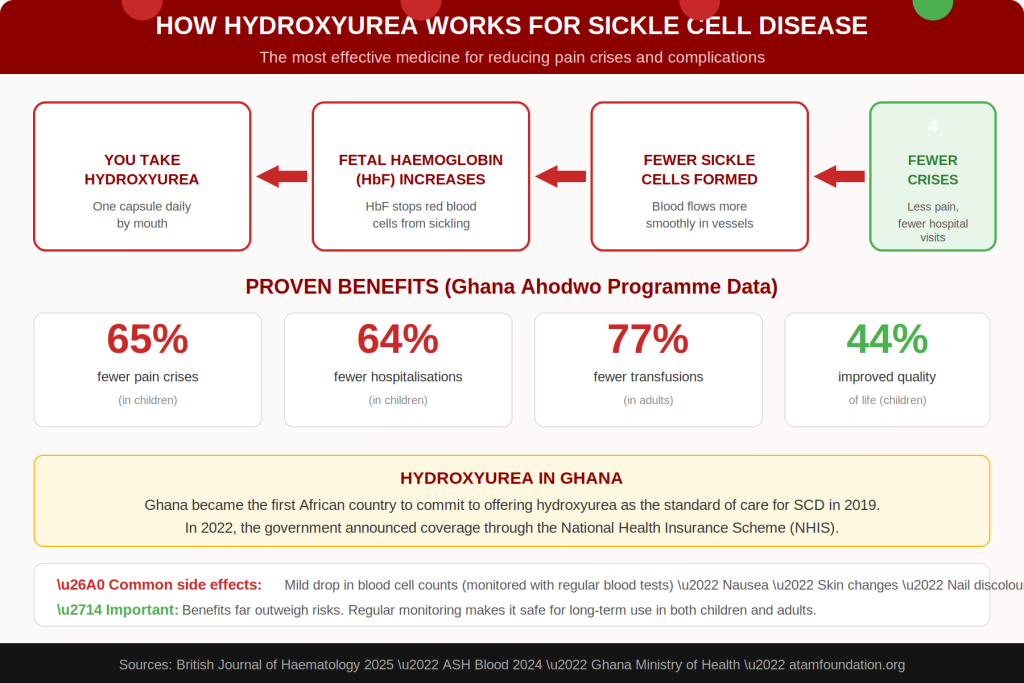
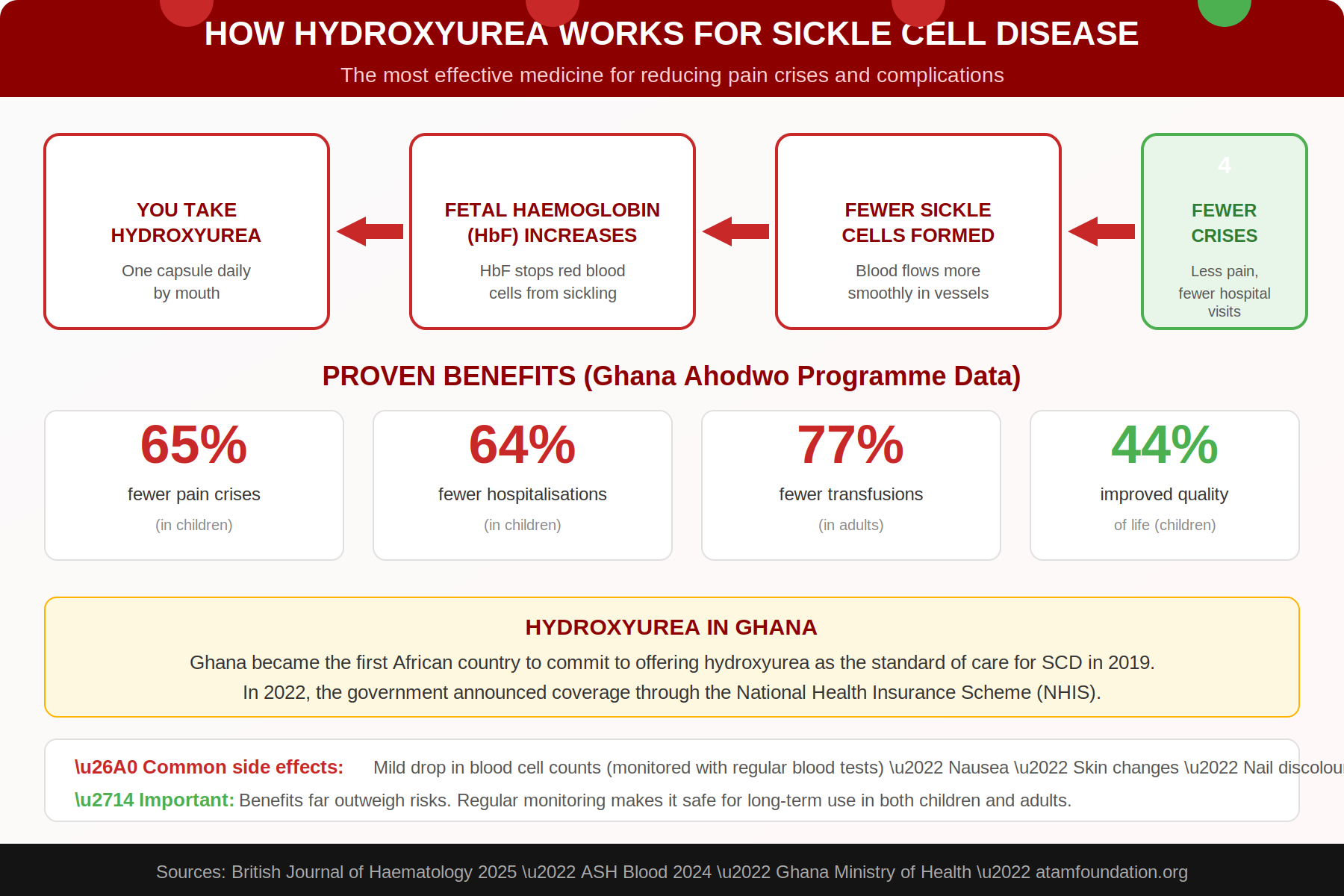
How hydroxyurea works — from increasing fetal haemoglobin to reducing pain crises. Data from the Ghana Ahodwo Programme.
How Hydroxyurea Works
To understand hydroxyurea, you first need to understand fetal haemoglobin (HbF). Before birth, your body makes a special type of haemoglobin called fetal haemoglobin. This type does not sickle.
After birth, your body gradually switches to making adult haemoglobin. In people with sickle cell disease, the adult haemoglobin (HbS) is the kind that causes red blood cells to become rigid and sickle-shaped.
Hydroxyurea works by reactivating fetal haemoglobin production. When your body makes more HbF, it makes less HbS. With fewer sickle-shaped cells in your bloodstream, there is less blockage in blood vessels, less pain, and less organ damage over time.
The medicine also has secondary benefits: it reduces the stickiness of red blood cells, lowers the white blood cell count (which reduces inflammation), and increases the overall water content of red blood cells, making them less likely to deform.
What the Evidence Shows
Hydroxyurea has been studied for over 30 years. Major clinical trials — including the landmark Multicenter Study of Hydroxyurea (MSH) in the United States and the REACH trial in Africa — have consistently shown that it reduces the burden of sickle cell disease across all age groups.
In Ghana, the results from the Ahodwo programme (named from the Akan word meaning “peace” or “relief”) are among the most compelling real-world evidence from anywhere in Africa.
The programme, launched through a partnership between the Ghana Ministry of Health, the Sickle Cell Foundation of Ghana and Novartis, has shown:
- 65% fewer pain crises in children on hydroxyurea
- 37% fewer pain crises in adults
- 64% fewer hospitalisations in children
- 63% fewer hospitalisations in adults
- 77% fewer blood transfusions in adults
- 66% fewer blood transfusions in children
- 44% improvement in quality of life in children, and 24% in adults
- 42–59% reduction in malaria episodes
Who Should Take Hydroxyurea?
Current clinical guidelines recommend hydroxyurea for:
- All children with sickle cell anaemia (HbSS) from age 9 months onwards — regardless of symptom severity. Early initiation prevents organ damage before it starts.
- Adults with SCD who have frequent pain crises (typically three or more per year)
- Patients with a history of acute chest syndrome, severe anaemia or stroke
- People with SCD who have evidence of organ damage
The decision to start hydroxyurea should always be made in partnership with your haematologist or SCD care team.
What to Expect When Starting Treatment
Hydroxyurea is taken as a single daily capsule by mouth. Here is what a typical treatment journey looks like:
Starting Dose
Your doctor will begin with a low dose (usually 15–20 mg/kg/day) and gradually increase it over weeks or months to find the optimal dose for you; the dose that gives the best HbF response while keeping blood counts in a safe range.
Regular Monitoring
You will need regular blood tests, typically every 4 to 8 weeks at first, then every 2 to 3 months once stable. These tests check your full blood count, especially white blood cells and platelets, to make sure the medicine is not suppressing your bone marrow too aggressively.
Timeline for Results
Most patients begin to notice a reduction in pain crises within 3 to 6 months. The full benefits — including improved haemoglobin levels and reduced organ damage — develop over the first 1 to 2 years of consistent use.
Long-Term Use
Hydroxyurea is a lifelong treatment. Stopping the medicine causes HbF levels to drop back down, and sickle cell symptoms typically return. If you are tolerating the medicine well and it is helping, the plan is to stay on it.
Side Effects and Safety
Like all medicines, hydroxyurea has side effects. The most important ones to know about:
- Mild drop in blood cell counts — this is expected and monitored through regular blood tests. If counts drop too low, the dose is reduced temporarily.
- Nausea — usually mild and often improves after a few weeks
- Skin and nail changes — some patients notice darkening of the nails or skin, which is harmless but can be cosmetically noticeable
- Temporary hair thinning — uncommon and usually reversible
Important safety note: Hydroxyurea should not be taken during pregnancy or by women who are actively trying to conceive, as it may harm a developing baby.
If you are of childbearing age and taking hydroxyurea, discuss contraception with your doctor. Men on the medicine should also seek guidance before planning a family. Our article on sickle cell in pregnancy covers family planning considerations in more detail.
Common Myths About Hydroxyurea
“Hydroxyurea is chemotherapy — it must be dangerous.”
Hydroxyurea was originally developed as a cancer drug, which is where the fear comes from. However, the doses used for sickle cell disease are much lower than those used in cancer treatment. Over three decades of research — including long-term follow-up studies — have shown that it is safe for lifelong use in both children and adults when monitored properly.
“It will make me infertile.”
Current evidence does not show that hydroxyurea causes permanent infertility at sickle cell doses. Studies have documented normal fertility in men and women who took the drug. However, because it can affect sperm production temporarily, men should discuss family planning timing with their doctor.
“My child is too young to start.”
Major international guidelines now recommend starting hydroxyurea from 9 months of age for children with HbSS. The earlier the start, the better the protection against organ damage that begins silently in infancy.
How to Access Hydroxyurea in Ghana
Access to hydroxyurea in Ghana has improved significantly since 2019. Here is how to get it:
- See your SCD care team — a haematologist or trained clinician will assess whether hydroxyurea is right for you and prescribe the correct starting dose.
- Fill your prescription — hydroxyurea is available at hospital pharmacies and many community pharmacies across Ghana.
- Check NHIS coverage — since 2022, the Ghana government has included hydroxyurea under the National Health Insurance Scheme, which can significantly reduce your out-of-pocket cost.
- Stay consistent — take your medicine daily as prescribed and attend all monitoring appointments. Consistency is the key to the best outcomes.
If cost remains a barrier, speak with your care team about the Ahodwo programme or contact the Sickle Cell Foundation of Ghana for support options.
Frequently Asked Questions
How long does it take for hydroxyurea to work?
Most patients notice a reduction in pain crises within 3 to 6 months of consistent use. Full benefits, including improved haemoglobin levels, develop over 1 to 2 years.
Can I stop taking hydroxyurea if I feel better?
No. Hydroxyurea is a maintenance treatment. If you stop, your HbF levels drop and sickle cell symptoms typically return. Always consult your doctor before making any changes to your medication.
Is hydroxyurea safe for children?
Yes. International guidelines recommend starting from 9 months of age for children with HbSS. The Ghana Ahodwo programme has shown significant benefits in children, including 65% fewer pain crises and 44% improvement in quality of life.
Does hydroxyurea cure sickle cell disease?
No. Hydroxyurea manages the symptoms and reduces complications, but it does not cure SCD. Currently, the only potential cure is a bone marrow (stem cell) transplant, which is not yet widely available in Ghana.
Is hydroxyurea covered by NHIS in Ghana?
Yes. In 2022, the Ghana government announced that hydroxyurea would be covered under the National Health Insurance Scheme, making it more affordable for patients across the country.