To understand sickle cell disease in Ghana, you need more than numbers, though the numbers are striking. Around 15,000 Ghanaian babies are born with the condition every year, and roughly one in four of us carries a sickle cell gene.
But behind those figures is a uniquely Ghanaian story: of a people who named this illness centuries before Western medicine did, of a clinic in Accra that became the largest of its kind in the world, and of real progress now being made.
Here are the facts, with the context that makes them matter.
What this article covers
- The key numbers at a glance
- How common is sickle cell disease in Ghana, really?
- What Ghana called sickle cell — long before 1910
- The diagnosis gap: why most children are found too late
- The progress: newborn screening and Ghana’s regional lead
- Where Ghana still falls short
- What this means for your family
- Frequently asked questions
The key numbers at a glance
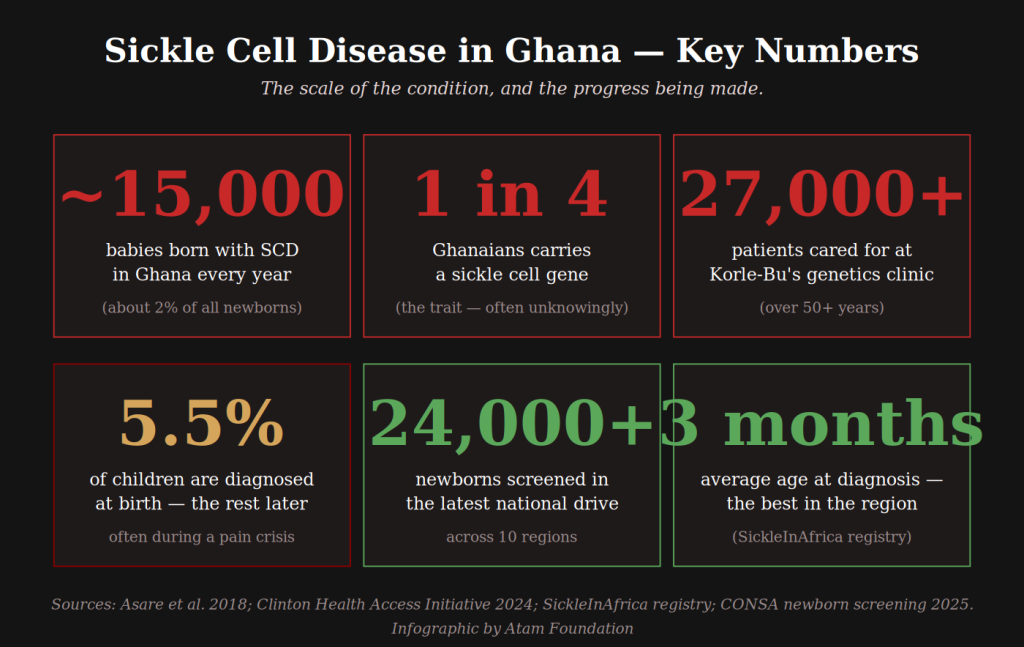
Key sickle cell disease statistics for Ghana. Infographic: Atam Foundation.
How common is sickle cell disease in Ghana, really?
Ghana sits in the part of the world most affected by sickle cell disease. The World Health Organization estimates that sub-Saharan Africa accounts for around 80% of sickle cell cases worldwide. Within that region, Ghana’s numbers are among the highest.
About 2% of Ghanaian newborns — roughly 15,000 babies a year — are born with sickle cell disease. And around one in four Ghanaians carries at least one sickle cell gene as a healthy carrier. Among Ghanaian patients, the two most common forms are HbSS (sickle cell anaemia) and HbSC, the latter being especially common in West Africa.
| A regional difference within Ghana. The picture is not uniform across the country. A 2025 study from Komfo Anokye Teaching Hospital found that among adults and adolescents in northern Ghana, the milder HbSC form made up a larger share (around 23%) than is typically seen in children — partly reflecting where different haemoglobin variants are concentrated, and partly because milder cases survive longer undiagnosed. Source: eJHaem, 2025 — KNUST / Komfo Anokye Teaching Hospital. |
What Ghana called sickle cell — long before 1910
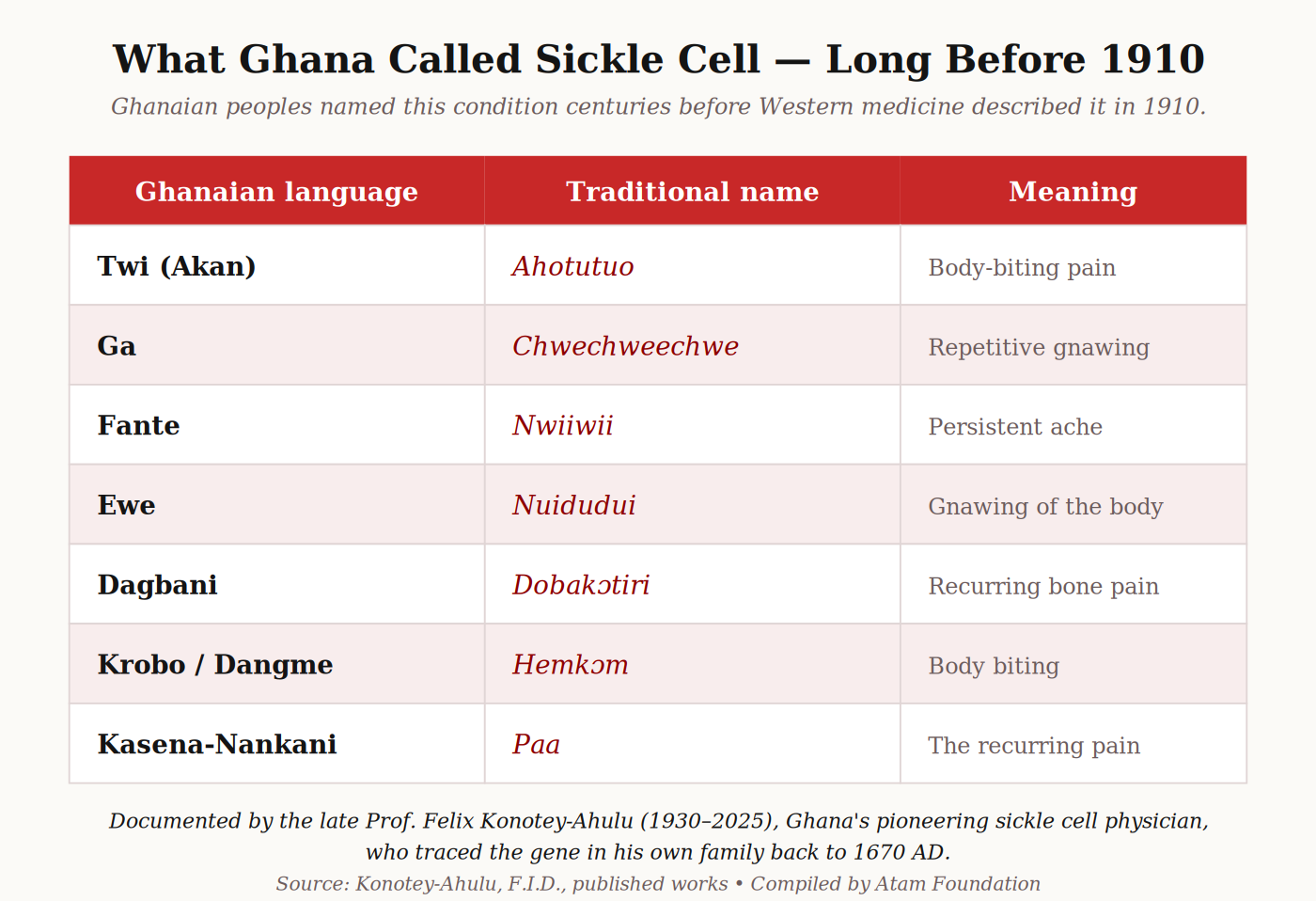
Here is something that almost no international article about sickle cell will tell you, and that every Ghanaian should know with pride. Western medicine first described sickle cell disease in 1910. But the people of Ghana had recognised, named, and tracked this illness for centuries before that.
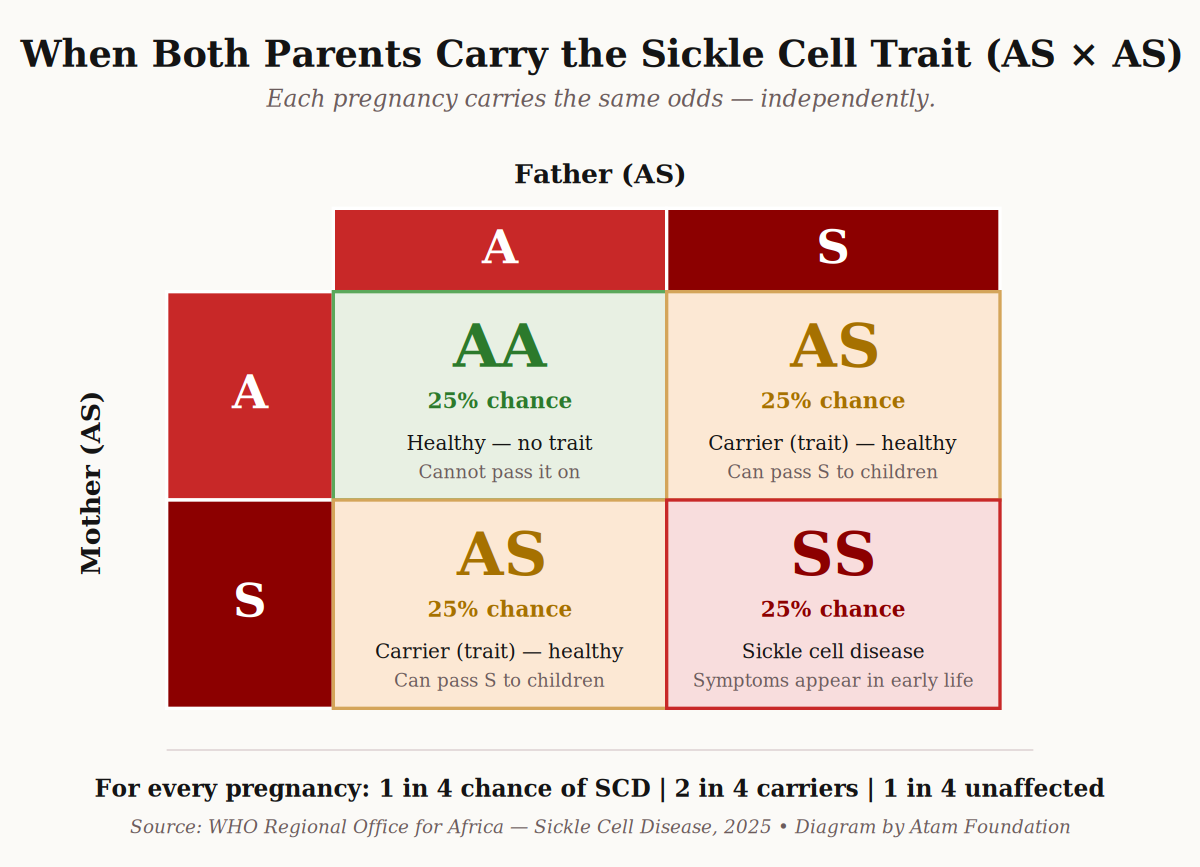
Across Ghana’s languages, families had specific names for the “hereditary cold-season rheumatism” — the recurring bone and joint pain that struck certain children, especially in the cold, wet months. They understood it ran in families. They understood it required two parents to pass it on, even when those parents seemed perfectly healthy.
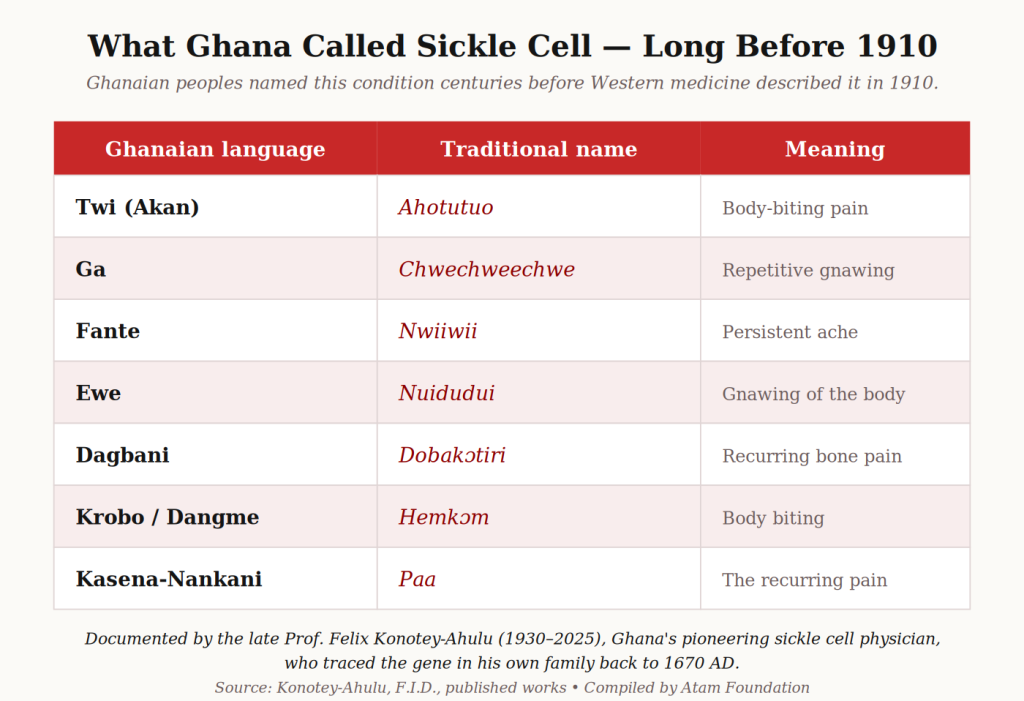
Traditional Ghanaian names for sickle cell disease across seven languages. Compiled by Atam Foundation from the work of Prof. Konotey-Ahulu.
Much of this knowledge was documented by one of Ghana’s greatest medical minds: Professor Felix Konotey-Ahulu (1930–2025). Born in Odumase-Krobo and educated at Achimota and the University of Ghana, he became one of the world’s foremost authorities on sickle cell disease.
He directed what became the largest sickle cell clinic in the world at Korle-Bu, and achieved something never done before in medical history: he traced the sickle cell gene through his own family, generation by generation, with named individuals, all the way back to 1670 AD.
Professor Konotey-Ahulu passed away in May 2025, but his legacy is a gift to every Ghanaian living with sickle cell today: the knowledge that this is not a foreign disease, not a curse, and not new. It is part of our story — and so is the determination to overcome it.
The diagnosis gap: why most children are found too late
Despite the high prevalence, a study of patients in Accra found that only 5.5% of children were diagnosed as newborns. Most were not identified until they were toddlers or older — and very often, the diagnosis came during a painful crisis, in an emergency room, after the child had already begun to suffer.
This matters because early diagnosis saves lives. When sickle cell is caught at birth, a baby can begin protective care immediately — penicillin to prevent infection, malaria prevention, the right vaccinations, and family education. Without it, the first sign of the disease is too often a medical emergency.
The progress: newborn screening and Ghana’s regional lead
The encouraging news is that Ghana is moving in the right direction — and in some respects, leading the continent. Ghana actually began targeted newborn screening back in the mid-1990s, and more than 170,000 newborns have been screened over the decades.
More recently, a national initiative led by the Ghana Health Service and partners — including the Sickle Cell Foundation of Ghana and the National Newborn Screening Laboratory at the Noguchi Memorial Institute for Medical Research — has expanded screening dramatically.
According to the Clinton Health Access Initiative, the program established 14 new screening sites across 10 regions and screened over 24,000 infants, linking diagnosed babies to care.
Ghana also leads its neighbours on early diagnosis. In the multinational SickleInAfrica registry, the average age at diagnosis was just 3 months in Ghana — compared with 19 months in Nigeria and 3 years in Tanzania. Ghana also had the region’s highest use of hydroxyurea, the medicine that reduces sickle cell crises. These are real achievements worth celebrating.
Where Ghana still falls short
Honesty matters. Despite the progress, Ghana — like every country in sub-Saharan Africa — still has no universal newborn screening programme. Screening reaches some regions far better than others.
Many families still face the disease without enough information, and stigma around genotype and marriage persists. Specialist care is concentrated in the big teaching hospitals, leaving rural families travelling long distances.
These gaps are exactly where awareness, advocacy, and organisations like Atam Foundation come in. Progress has been made — but it is not yet shared equally by every Ghanaian family.
What this means for your family
- Know your genotype — and your partner’s.
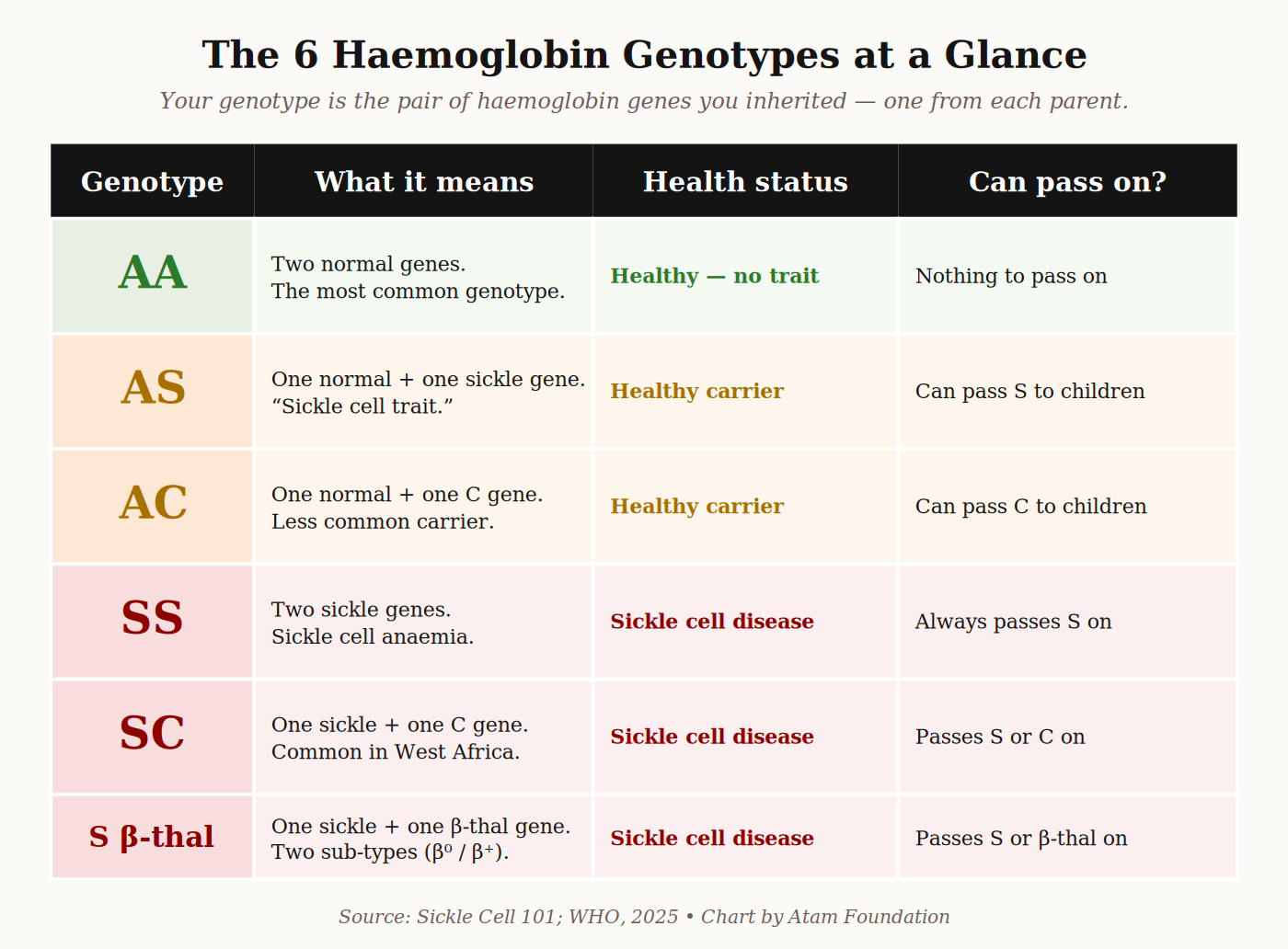
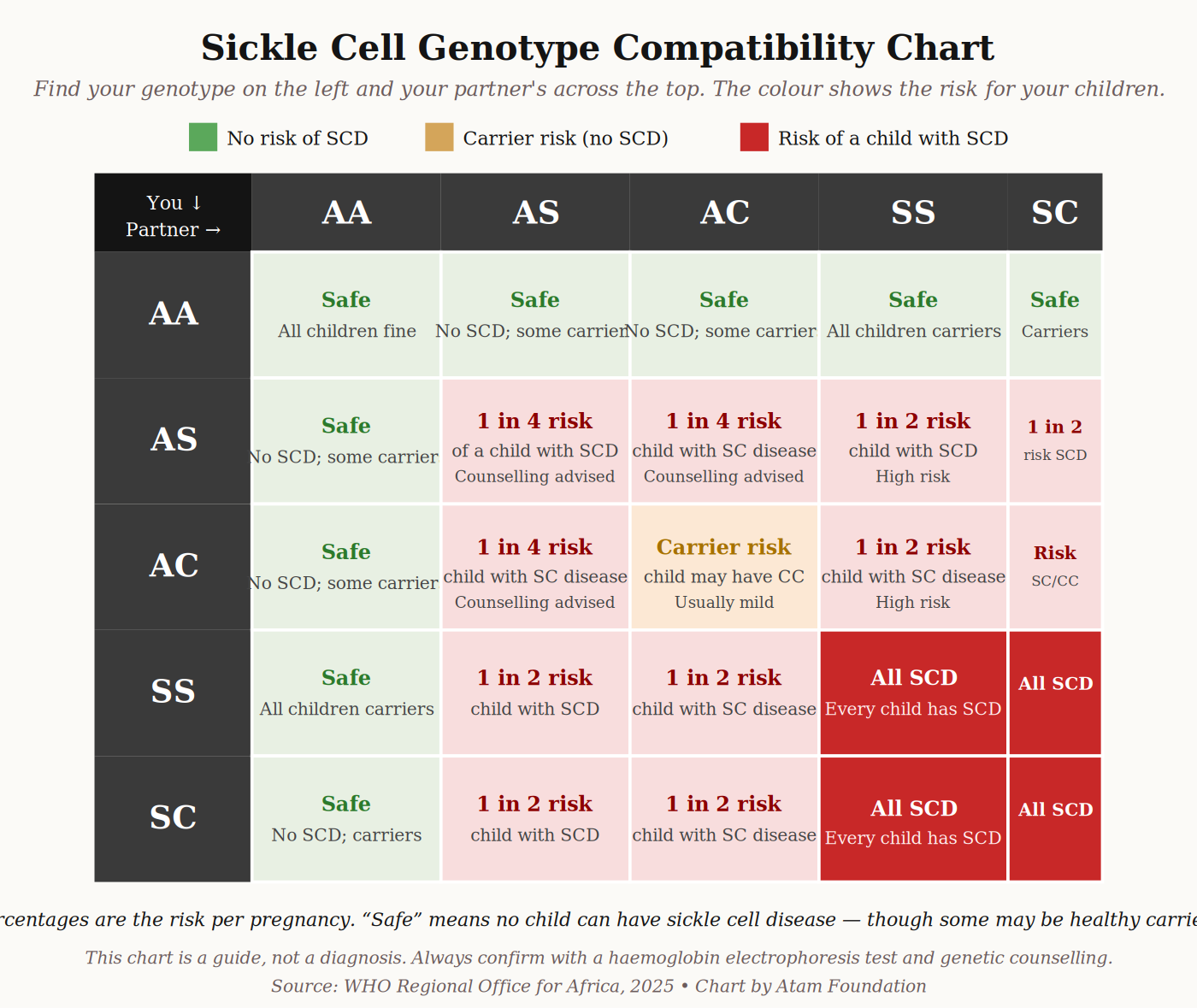
With one in four Ghanaians carrying a sickle cell gene, testing is not just for “other people.” See our genotype guide and compatibility chart.
- If you have a newborn, ask about screening.
Do not wait for symptoms. Ask your hospital whether sickle cell newborn screening is available — and push for it if it is not offered.
- If sickle cell runs in your family, seek specialist care early.
Korle-Bu, KATH and a growing number of regional facilities offer dedicated care. Early management changes outcomes.
- Help break the stigma.
Sickle cell is part of Ghana’s story, not a source of shame. Talking about it openly saves lives.
Frequently asked questions
How many people in Ghana have sickle cell disease?
Around 2% of Ghanaian newborns — roughly 15,000 babies a year — are born with sickle cell disease. About one in four Ghanaians carries a sickle cell gene as a healthy carrier. These rates are among the highest in the world.
Why is sickle cell so common in Ghana?
The sickle cell gene became common in West Africa because carrying one copy (the trait) offers some protection against severe malaria. Over many generations in a malaria-endemic region, this kept the gene widespread — which also means more children inherit two copies and develop the disease.
Does Ghana have newborn screening for sickle cell?
Ghana has targeted newborn screening that has expanded significantly in recent years, with new sites across 10 regions. However, there is still no universal national programme, so coverage is uneven. Always ask your hospital whether screening is available.
Who was Felix Konotey-Ahulu?
Professor Felix Konotey-Ahulu (1930–2025) was a Ghanaian physician and one of the world’s foremost sickle cell experts. He directed the largest sickle cell clinic in the world at Korle-Bu and traced the sickle cell gene in his own family back to 1670 AD — a first in medical history.
Can you live a normal life with sickle cell disease in Ghana?
Yes — increasingly so. With early diagnosis, good management (folic acid, hydroxyurea, infection and malaria prevention) and specialist care, many Ghanaians with sickle cell disease live full adult lives. The oldest patient in one Korle-Bu cohort was in her late 80s.
Ghana’s story is still being written
The numbers are heavy, but they are not the whole story. Ghana named this disease before the world did, built one of its great centres of care, and now leads its region on early diagnosis.
The next chapter — universal screening, equal care for every region, an end to stigma — is one we can write together.