If someone has ever asked you “what is your genotype?” and you weren’t quite sure what they meant — or why it mattered — you are far from alone.
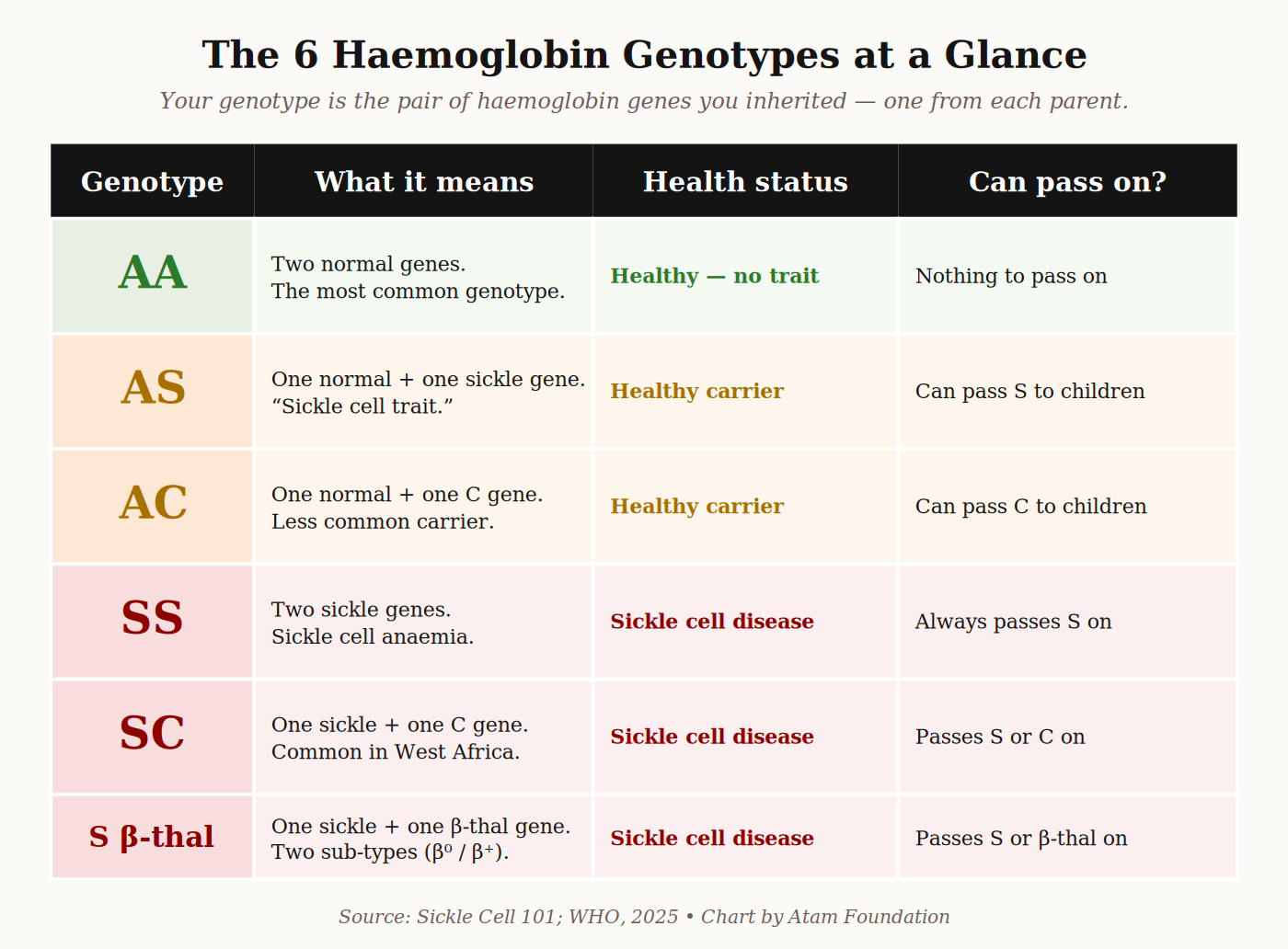
Your sickle cell genotype is simply the pair of haemoglobin genes you inherited, one from each parent. Those two letters — AA, AS, AC, SS, SC, or S β-thal — carry more weight for your health and your future family than almost any other piece of information about your body.
This guide explains each one in plain language, with a Ghanaian lens.
What this guide covers
- What a genotype actually is (and how it differs from blood group)
- The six genotypes at a glance
- AA, AS and AC — the “non-disease” genotypes
- SS, SC and S β-thalassaemia — the disease genotypes
- Why “trait” is not “disease” — the most important distinction
- How genotype is tested in Ghana (and why the test type matters)
- What to do once you know your genotype
- Frequently asked questions
What a genotype actually is and how it differs from blood group
This is the single most common confusion we hear at Atam, so let us clear it up first. Your blood group (A, B, AB, O, with a positive or negative Rhesus factor) is about the markers on the surface of your red blood cells.
It matters for blood transfusions and pregnancy. Your genotype, in the sickle cell sense, is about the type of haemoglobin inside those red blood cells — the protein that carries oxygen.
You can be blood group O positive and genotype AA. You can be O positive and genotype SS. The two are completely independent. Knowing one tells you nothing about the other. For sickle cell, it is the genotype you need.
Each of us carries two haemoglobin genes. The healthy version is written A. The sickle version is S. A third version, common in West Africa, is C. And a separate disorder called β-thalassaemia can also pair with S. Your genotype is just the combination of the two you happened to inherit.
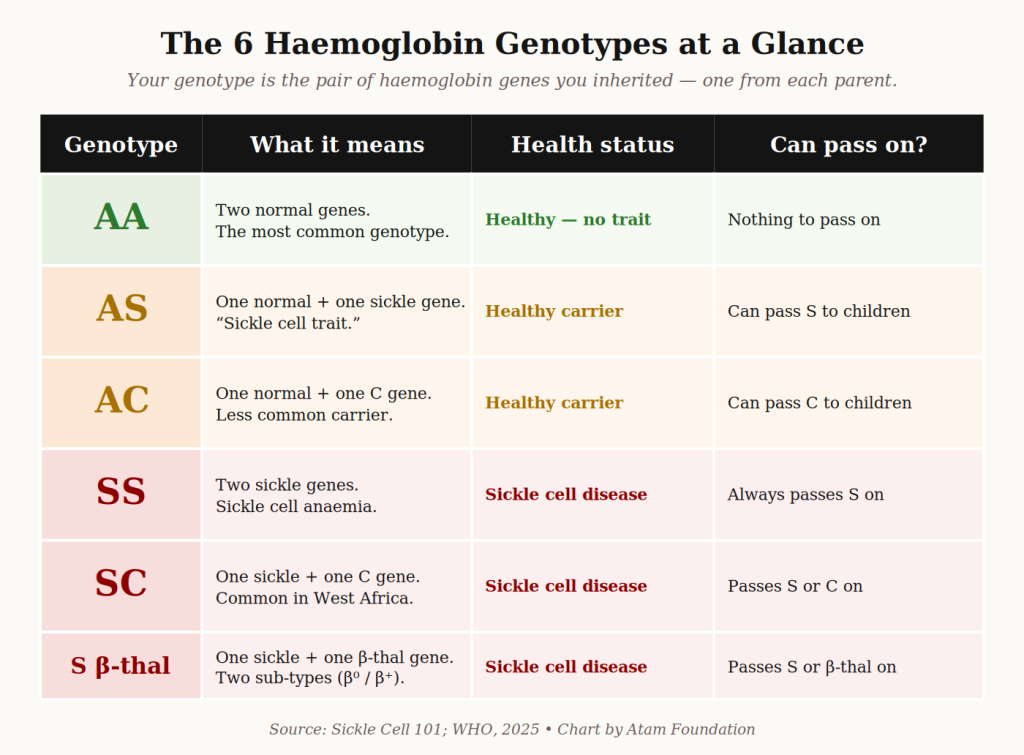
The six haemoglobin genotypes and what each one means for your health. Chart: Atam Foundation.
AA, AS and AC — the genotypes that are not a disease
AA — two normal genes
If you are AA, you inherited a normal haemoglobin gene from each parent. You do not have sickle cell disease, you do not carry the sickle gene, and you cannot pass it on. AA is the most common genotype in Ghana, though far less dominant than many people assume — roughly one in four Ghanaians carries at least one sickle or C gene.
AS — sickle cell trait
If you are AS, you inherited one normal gene and one sickle gene. This is called sickle cell trait. Here is the crucial point: AS is not a disease. Your body makes more normal haemoglobin than sickle haemoglobin, so your red blood cells stay healthy and flexible under almost all normal conditions. The vast majority of people with AS live completely normal lives and never know they carry it unless they are tested.
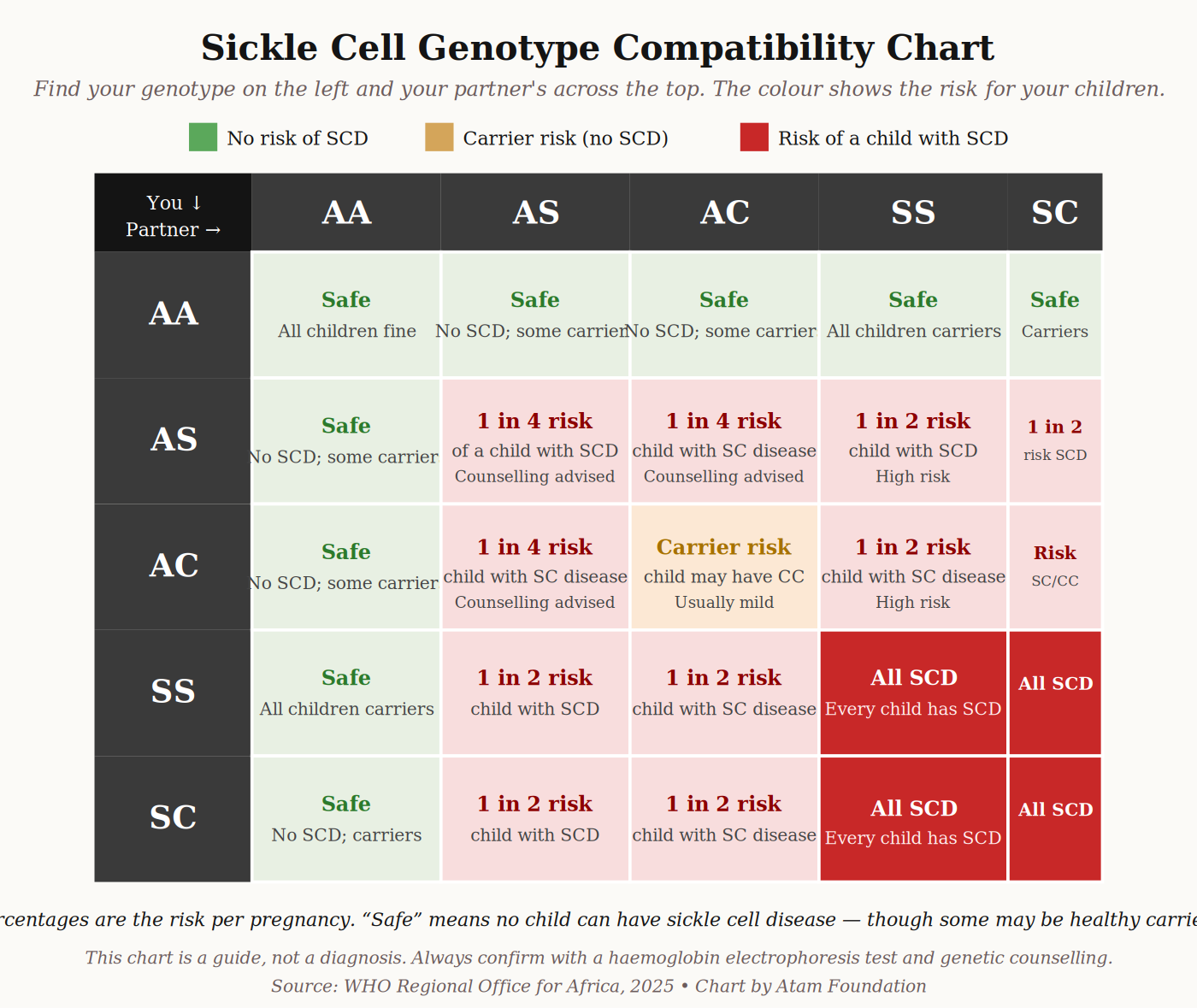
The one thing AS means is that you can pass the S gene to your children. That is why it matters most when choosing a partner and planning a family — which we cover in depth in our genotype compatibility guide.
AC — the less common carrier
If you are AC, you carry one normal gene and one C gene. Like AS, this is a carrier state, not a disease, and AC individuals are generally healthy. The C gene is found almost exclusively in people of West African ancestry — which is exactly why it appears in Ghanaian families and rarely elsewhere in the world. AC matters for the same reason AS does: it can combine with a partner’s S or C gene in your children.
| Very rare, but worth knowing: very rarely, people are tested as ‘CC’ (two C genes). This is a mild condition, much gentler than sickle cell disease, but still worth discussing with a doctor. |
SS, SC and S β-thalassaemia — the disease genotypes
These three genotypes all mean a person has sickle cell disease. We explain how each type behaves differently in our companion article, The 4 Types of Sickle Cell Disease Explained. Here is the short version:
- SS — two sickle genes. Sickle cell anaemia, the most common and usually most severe form in Ghana.
- SC — one sickle gene and one C gene. Common in West Africa, often milder than SS, but with its own complications (especially eye and bone problems).
- S β-thalassaemia — one sickle gene and one β-thalassaemia gene. Rarer, with two sub-types: β⁰ (behaves like SS) and β⁺ (usually milder).
All three require ongoing medical care, but with good management — folic acid, hydroxyurea where appropriate, prompt treatment of infections and malaria — people with these genotypes live full lives in Ghana today.
Why “trait” is not “disease” — the distinction that changes everything
This is the misunderstanding that causes the most unnecessary worry — and, sometimes, the most preventable heartbreak. People hear they have “sickle cell” something and panic, or hear “just the trait” and dismiss it entirely. Both reactions miss the mark.
A carrier (AS or AC) has the trait. They are healthy. The trait does not turn into the disease later in life — that is a myth. A person with the disease (SS, SC, S β-thal) has two affected genes and will experience symptoms that need management.
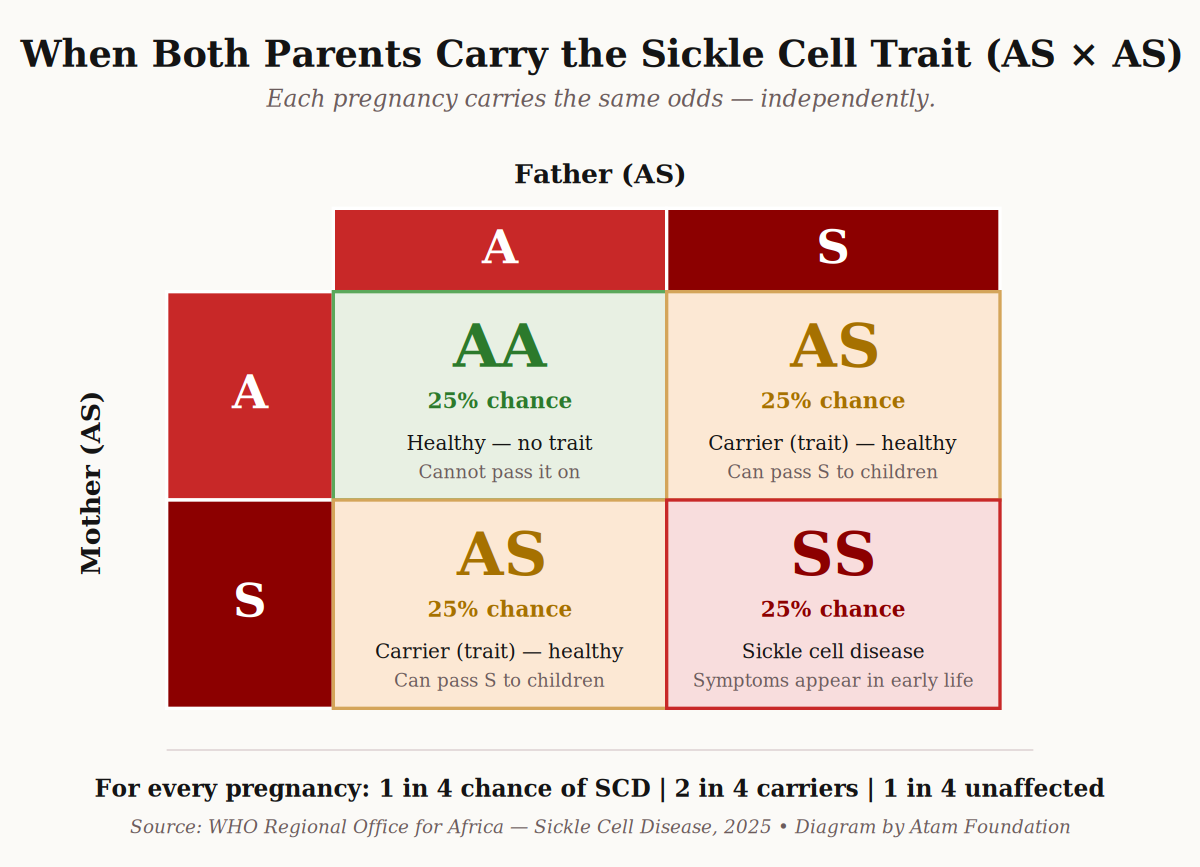
The reason the trait still matters is entirely about the next generation. Two healthy carriers can, without any warning signs in themselves, have a child with the full disease. That is not a reason for fear — it is a reason for knowledge. And knowledge starts with a simple test.
How genotype is tested in Ghana
Here is something most online genotype guides never mention, and it can be the difference between a correct and an incorrect result. There are two main ways your genotype can be tested, and they are not equally reliable:
The solubility test (“sickling test”) — a screening tool only
This quick, cheap test only tells you whether the S gene is present at all. It cannot tell AS apart from SS, and it cannot detect the C gene. It is a screening test, not a diagnosis. Unfortunately, some clinics still report it as if it were a full genotype.
Haemoglobin electrophoresis — the proper test
This is the test you actually want. It separates out the different haemoglobin types and gives you your true genotype — AA, AS, AC, SS, SC, and so on. It is available at Korle-Bu Teaching Hospital in Accra, Komfo Anokye Teaching Hospital (KATH) in Kumasi, regional hospitals, and many reputable private laboratories across Ghana.
One more Ghana-specific note: testing a newborn can sometimes give an unclear result, because babies still carry a lot of fetal haemoglobin (HbF) in their first months. Specialised newborn screening accounts for this, but a standard electrophoresis on a very young baby may need repeating later. Ask your clinic.
What to do once you know your genotype
- Write it down and keep it safe.
Save it in your phone, tell your spouse, note it in any health records. You should never have to guess it again.
- If you are AA — share the value of testing.
You are not at risk of passing on sickle cell, but most of the people you love have never been tested. Encourage them.
- If you are a carrier (AS or AC) — know it matters for family planning.
Before marriage or before trying for a baby, make sure you and your partner both know your genotypes. Our compatibility guide explains the combinations.
- If you have a disease genotype (SS, SC, S β-thal) — connect with care.
A haematology clinic and an organisation like Atam Foundation can help you live well, not just survive.
Frequently asked questions
Can my genotype change over time?
No. Your genotype is fixed from conception and stays the same for life. If two tests give different results, one of them is wrong — usually because a screening test was mistaken for a full electrophoresis. Re-test at an accredited lab.
What is the most common genotype in Ghana?
AA is the most common single genotype, but Ghana has an unusually high carrier rate — roughly one in four people carries at least one S or C gene. This is why sickle cell is so prevalent here.
Is AS the same as having sickle cell disease?
No. AS is sickle cell trait — a healthy carrier state. People with AS do not have the disease and do not develop it later. AS only matters for the genotype of future children.
How much does a genotype test cost in Ghana?
Costs vary by facility, but haemoglobin electrophoresis is widely affordable at public hospitals and many private labs. Some NHIS packages and antenatal services include it. Ask your nearest hospital or lab for current pricing.
My blood group is O+. What is my genotype?
Blood group tells you nothing about your genotype — they are completely separate. You need a haemoglobin electrophoresis test to find out your genotype.
Know your letters; it changes everything
Your genotype is two small letters, but they hold real power: the power to plan, to prepare, and to protect the next generation. If you do not yet know yours, let this be the week you find out.