Few questions carry as much weight in a Ghanaian relationship as this one: “are our genotypes compatible?” A sickle cell compatibility chart answers it clearly — showing, for every combination of two partners’ genotypes, the chance of having a child with sickle cell disease.
But a chart alone is not enough.
This guide gives you the chart and something most pages leave out: honest, compassionate guidance for couples who find themselves at risk — including those already in love, or already married.
What this guide covers
- The compatibility chart — read it in 30 seconds
- What the chart is really telling you
- The genotype combinations that are completely safe
- The combinations that carry risk — and exactly how much
- “We are both carriers and already in love.” What now?
- The real options for at-risk couples in Ghana
- How to have the genotype conversation early
- Frequently asked questions
The sickle cell compatibility chart
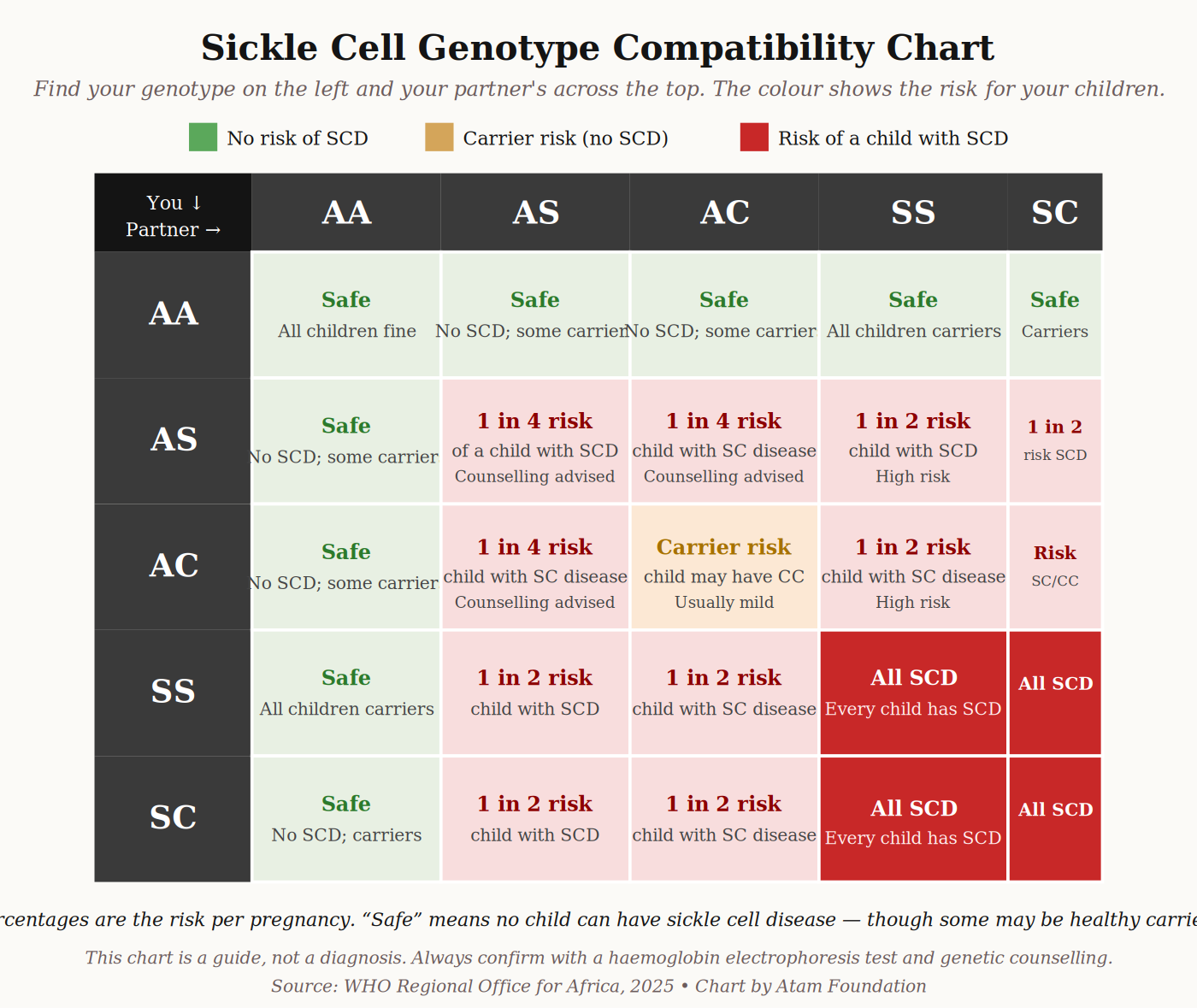
Find your own genotype down the left side, and your partner’s across the top. The colour of the box where they meet tells you the risk for your children. Green means no child can have sickle cell disease. Red means there is a real chance, and the box tells you how big that chance is.
The full genotype compatibility chart for couples. Percentages show the risk per pregnancy. Chart: Atam Foundation.
What the chart is really telling you
Two ideas make the whole chart make sense. First: a child can only have sickle cell disease if both parents pass on an affected gene (S or C). If even one parent is AA, no child of theirs can have the disease — though some may be healthy carriers.
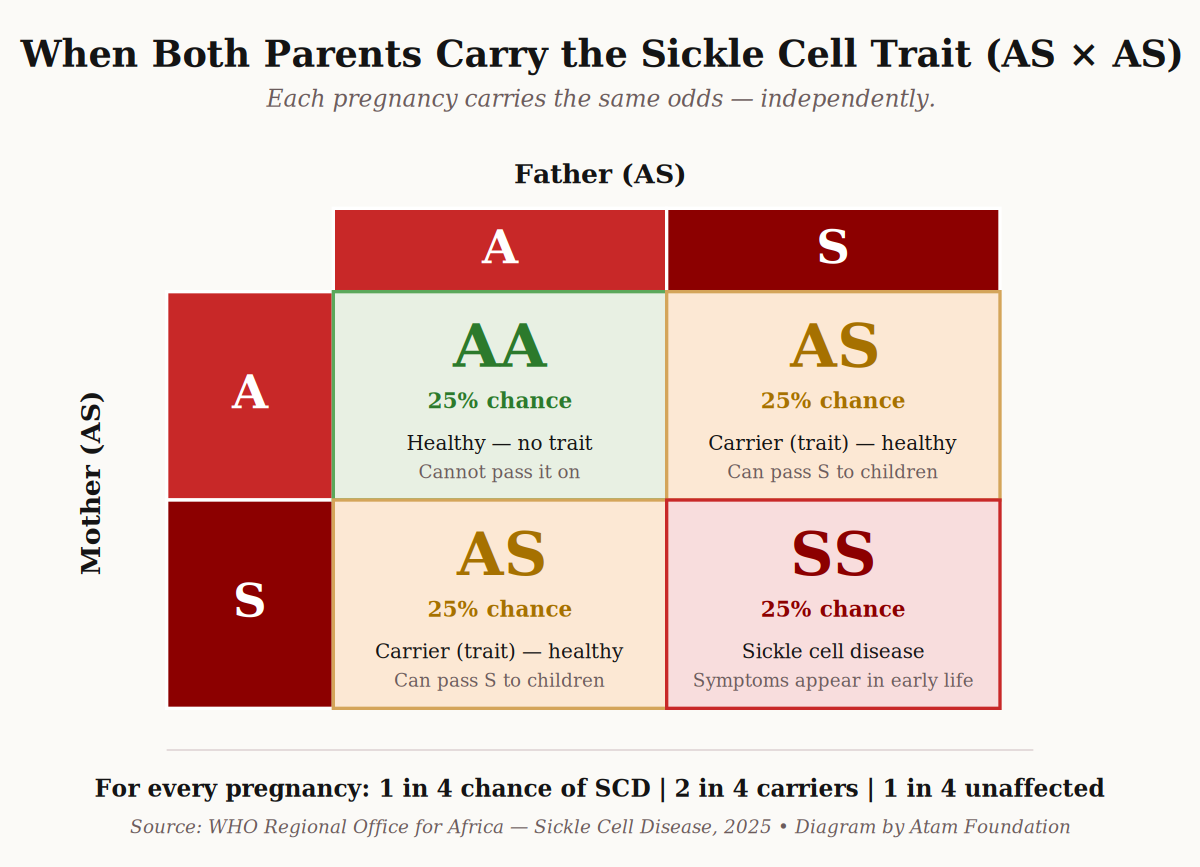
Second: the percentages are per pregnancy, and they reset every time. A 1-in-4 risk does not mean “one of your four children.” Each pregnancy independently carries the same odds, like rolling dice afresh each time.
This second point matters enormously, and it is where many families are caught out. We have heard people say, “Our first three are fine, so the fourth will be too.” That is not how it works. Every pregnancy starts the odds over.
The completely safe combinations
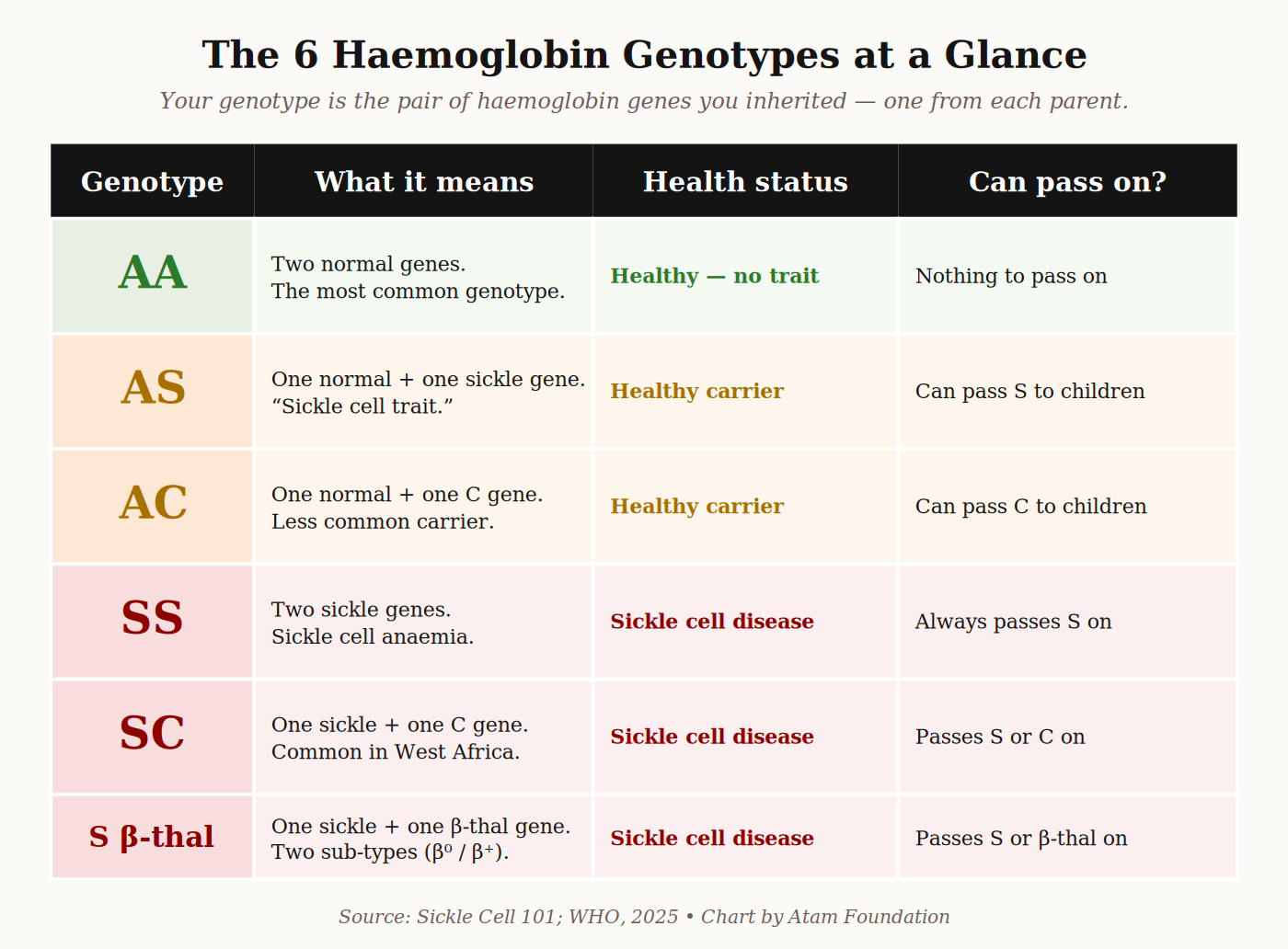
If you or your partner is AA, you are in the clear as far as sickle cell disease goes. An AA person can pair with any genotype — AA, AS, AC, SS, SC — and none of their children will have sickle cell disease.
Some children may be carriers (AS or AC), which simply means the condition passes to the next generation, but no child will have the disease itself.
This is the single most reassuring fact in the whole topic, and it is worth repeating: AA + anything = no sickle cell disease in the children.
The combinations that carry risk — and exactly how much
Risk appears when both partners carry an affected gene. The most important ones for Ghanaian couples:
- AS + AS — 1 in 4 chance (25%), each pregnancy, of a child with sickle cell disease (SS). 1 in 2 will be carriers; 1 in 4 fully unaffected.
- AS + AC — 1 in 4 chance, each pregnancy, of a child with SC disease.
- AS + SS — 1 in 2 chance (50%), each pregnancy, of a child with sickle cell disease.
- SS + SS, SS + SC, SC + SC — every child will have sickle cell disease.
These are real risks, and they are the reason genotype testing before marriage is so strongly encouraged across Ghana. But a risk is not a verdict — and what a couple does with this information is deeply personal.
“We are both carriers and already in love.” What now?
If you have read this far with a sinking feeling because you and someone you love are both carriers — please take a breath. You are not the first, you are not doing anything wrong, and you are not out of options.
At Atam, this is one of the most common conversations we have, and it is never one we approach with judgement.
Here is what we want you to know. Being told “you two should not marry” is the old way of handling this. And for many couples, it is neither realistic nor kind. Love is already present. What matters now is making an informed decision together, with full knowledge of the risks and the real options available to you.
| If you are an at-risk couple, you have more choices than you may thinkThe decision is yours alone — but it should be made with facts, not fear, and ideally with a genetic counsellor beside you. The next section lays out what is actually possible in Ghana today. |
The real options for at-risk couples in Ghana
1. Genetic counselling
Before any decision, talk to a genetic counsellor. They will explain your specific risk, answer your questions privately, and help you and your partner think clearly without pressure. This service is available through teaching hospitals and is something Atam can help you access.
2. Prenatal diagnosis
For couples who conceive, it is possible to test the baby during pregnancy to find out its genotype. This gives parents time to prepare — emotionally, medically, and practically — for a child who may have the disease, and to ensure that child receives life-saving care from birth.
3. Pre-implantation genetic diagnosis (PGD)
For couples using IVF, embryos can be tested before implantation so that only unaffected embryos are selected. PGD is not yet widely available in Ghana and is costly, but awareness is growing, and some couples travel or save toward it.
4. Other paths to parenthood
Some couples choose adoption or the use of a donor. These are deeply personal decisions, and there is no single right answer. What matters is that the choice is yours, made with full information.
5. Choosing to proceed, fully informed
Some couples, knowing the risk, choose to have children anyway — and prepare to give any child with sickle cell the best possible care. With early diagnosis and modern management, children with sickle cell disease in Ghana increasingly grow into thriving adults. This is a valid, loving choice too.
How to have the genotype conversation early
The single kindest thing any couple can do is to have this conversation before hearts are fully committed — not to avoid love, but to face it with open eyes. A few gentle suggestions:
- Make it mutual, not an interrogation.
Frame it as “let’s both get tested” rather than “what is your genotype?” It is something you do together.
- Do it early in a serious relationship.
The longer you wait, the harder it becomes to act on a difficult result. Early knowledge protects both of you.
- Use a proper test.
Insist on haemoglobin electrophoresis, not just a sickling test. See our genotype guide for why this matters.
- Bring in support if the result is hard.
A genetic counsellor — or Atam Foundation — can help you both process and plan, without judgement.
Frequently asked questions
Can two people with AS genotype marry?
Yes, they can. Many AS + AS couples marry and build happy families. The chart shows a 1-in-4 risk per pregnancy of a child with sickle cell disease, so the important thing is to know this in advance, seek genetic counselling, and make an informed decision together about your options.
Is it true that AS should only marry AA?
That is the cautious traditional advice, and AS + AA does carry no risk of a child with the disease. But “should” is a personal matter. Plenty of at-risk couples marry and navigate it thoughtfully. The goal is informed choice, not a rule that ignores the reality of love.
If our first child does not have sickle cell, are the others safe?
No. Each pregnancy carries the same independent odds. A 1-in-4 risk applies to every pregnancy, regardless of previous children. This is one of the most important and most misunderstood facts.
Does blood group compatibility matter too?
Blood group (and Rhesus factor) matters for pregnancy safety, especially if the mother is Rhesus-negative — but it is completely separate from genotype compatibility. For sickle cell, it is the genotype that counts.
Where can we get genetic counselling in Ghana?
Genetic counselling is available through teaching hospitals such as Korle-Bu and KATH, and through some private clinics. Atam Foundation can help connect you with trusted services and walk alongside you.
Knowledge, not fear
A compatibility chart is a tool, not a sentence. Whatever your genotypes, knowing them early gives you the one thing every couple deserves: the power to choose your path with open eyes and full hearts.